
On-Site vs Off-Site Secure Data Destruction Service in Singapore
: A Head-to-Head Decision
Neither model is automatically better. On-site secure data destruction removes the point at which your media leaves your control; off-site secure data destruction centralises the destruction equipment, the CCTV record and the documentation trail in one place. For most Singapore buyers in the evaluation stage, the correct answer is not a preference for one model but a rule that assigns each media class to the route that produces the strongest, most auditable evidence at the lowest custody risk.
The Problem: Every Handover Is a Custody Gap
Secure data destruction means the complete and irreversible removal of data from storage devices so that it cannot be accessed again. That definition is straightforward. The operational difficulty sits in the gap between your premises and the destruction event, because in that gap the asset is neither under your control nor yet destroyed.
A buyer evaluating a Secure Data Destruction Service is effectively asked to accept four things at once: that the media collected is the media destroyed; that nobody accessed it in transit; that the destruction method was appropriate for the specific device; and that the resulting proof will satisfy an auditor who was not present. Every one of those four questions becomes easier or harder depending on whether destruction happens on your site or at a supplier's facility.
The custody variables that actually matter are concrete and checkable:
- Container control – whether media sits in a sealed locked box with restricted keys, or loose in a tote.
- Inventory control – whether each item is barcode-scanned at the point of collection, at the destruction point, or both.
- Observation control – whether destruction is witnessed in person, recorded on CCTV, or evidenced only by a signature on a certificate.
- Method control – whether the destruction method matches the media: magnetic hard drives, NAND-based SSDs, mobile devices and paper all behave differently.
On-site and off-site models distribute these controls differently, which is why the decision should be made per media class rather than once for the whole organisation.
Why the Choice Matters More in Singapore Now
Data destruction has moved from a facilities housekeeping task to a line item with its own audit trail. The global IT Asset Disposition (ITAD) market, which includes data destruction services, was valued at USD 17.5 billion in 2024 and is expected to reach USD 29.54 billion by 2030, according to Strategic Market Research. Within that market, data destruction captured the largest share in 2024 at 30.64%.
Volume pressure explains part of the growth. Global e-waste generation reached 62 million tonnes in 2022 and is projected to reach 74.7 million tonnes annually by 2030, per the Global E-waste Monitor 2024 published by UNITAR and ITU. Each retiring device is a data-bearing device until it is destroyed, wiped or certified.
Method discipline explains the other part. NIST Special Publication 800-88 Revision 1, Guidelines for Media Sanitization, defines three sanitization levels: Clear, Purge and Destroy. Buyers rarely need to memorise the standard, but they do need to know which level a supplier is claiming, because Destroy (physical reduction) and Purge (for example degaussing magnetic media) produce different evidence and suit different media.
In Singapore, the practical consequence is that enterprise buyers, data centre operators, healthcare institutions and financial services teams increasingly receive the same request from internal audit: show that the asset no longer exists in readable form, and show who held it in between. The on-site versus off-site decision is the first fork in producing that answer.
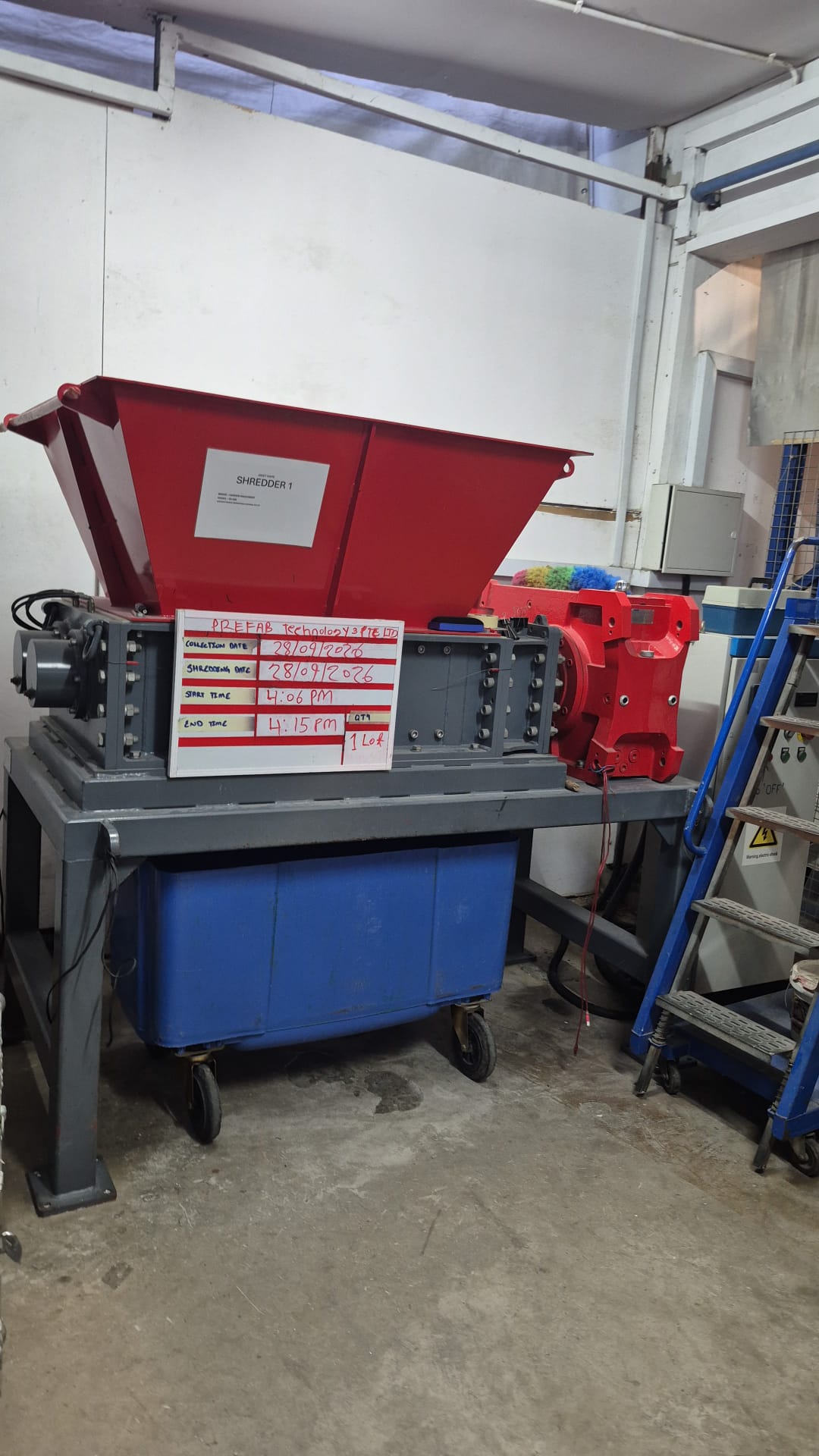
Industrial shredding equipment used in secure destruction workflows. Equipment location determines whether destruction can happen on the client's premises or at a secure facility.
How the Two Models Actually Work
BigVoice Secure Destruction Pte. Ltd. is a Singapore-based provider of secure data destruction and IT asset disposal services for electronic and non-electronic assets, and it operates both on-site and off-site destruction to meet different customer requirements. Its declared service scope covers hard drives, laptops, mobile devices, IT equipment, confidential documents and other data-bearing media. That dual-model structure is useful for this comparison because the same supplier, the same inventory system and the same certificate format sit behind both routes — so the difference is genuinely about custody design, not about two different vendors.
Route A — Off-Site Destruction
In the off-site model, media is consolidated at your premises, sealed into containers, scanned, transported to a secure destruction facility, destroyed there, and evidenced afterwards. BigVoice Secure operates a 99.45 m² secure storage and destruction site in Singapore and states that collection vehicles are GPS-tracked as items move to the secure destruction facility.
The strength of this route is industrial concentration. The facility houses the heavy equipment: industrial shredders and crushers, an SV91m degausser described as meeting NATO/NSA requirements, and HDD drilling tools. Large volumes of mixed media can be processed without your site having to accommodate machinery, power requirements or a destruction window that disrupts operations.
The weakness is obvious and should be stated plainly: between collection and destruction, your media is in someone else's custody. That gap is managed, not eliminated — locked boxes, barcode scanning, GPS-tracked vehicles and CCTV-monitored destruction all exist to make the gap observable.
Route B — On-Site Destruction
In the on-site model, destruction happens at your premises. BigVoice Secure maintains trained collection and destruction teams capable of executing on-site or secure-facility destruction while maintaining chain-of-custody records, and it supports both on-site and off-site scanning and inventory.
The strength of this route is that the custody gap collapses to minutes rather than hours or days. For media that the organisation is unwilling to let leave the building — regulated records, executive devices, investigation material, or anything where removal itself is a reportable event — on-site destruction answers the question an auditor will actually ask: did the drive ever leave?
The weakness is logistical. On-site work depends on equipment deployment, site access, power and safety arrangements during the destruction window. Buyers should confirm at quotation stage which destruction methods can be executed on their premises for their specific media, rather than assuming the full equipment set travels.
Custody Controls That Apply to Both Models
The controls below are not alternatives to the on-site/off-site choice; they are the layer that makes either choice defensible.
- Locked boxes. Sealed containers restrict who can access media before destruction and create a defined point at which the client hands over control.
- Barcode and scan inventory. Each item is scanned into an inventory record, so the destruction list is a data set rather than a handwritten estimate. BigVoice Secure uses barcode asset scanning and a secure inventory tracking system, with scanning available on-site or off-site.
- Optional on-site scanning. Where the client wants serial numbers captured before anything moves, scanning can be performed at the client's premises as part of the collection step.
- CCTV monitoring and viewing. CCTV-monitored destruction with chain-of-custody documentation is offered, and customers can request CCTV viewing of the destruction process for transparency. A CCTV viewing link can be issued as a deliverable alongside the certificate.
- Certificate of Destruction. A formal Certificate of Destruction is issued to the client after completion of destruction to evidence secure disposal.
What the Evidence Package Should Contain
Documentation is where the two routes converge. BigVoice Secure issues a Certificate of Destruction on completion, and its documented proof assets include collection records, service orders, delivery orders, destruction reports or waste summary reports, and — where applicable — buyback payment receipts and CCTV viewing links. In a reported engagement, 100% of completed projects were issued a signed Certificate of Destruction, and the destruction certificates were described as audit-ready.
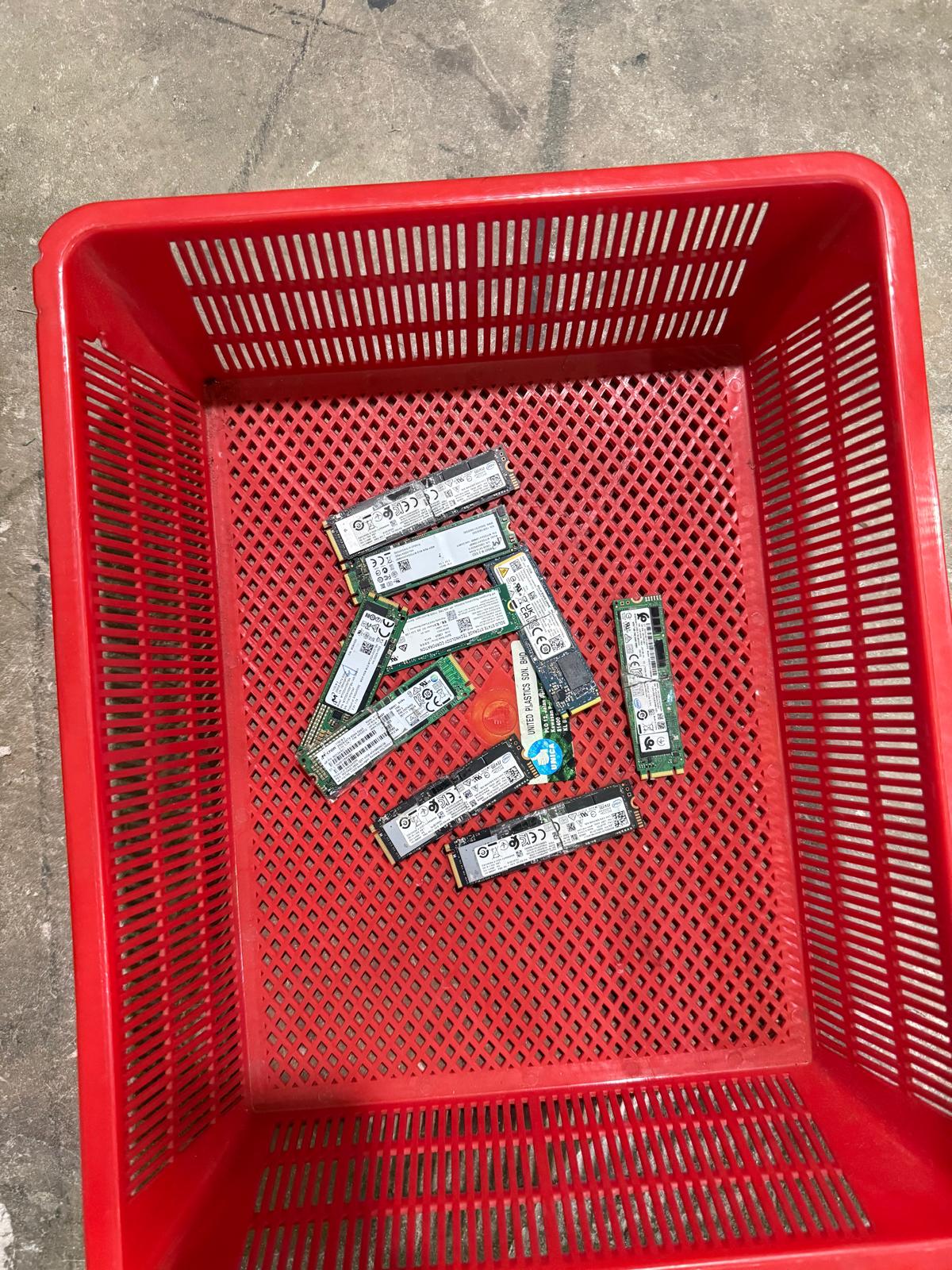
M.2 SSD media before destruction. NAND-based media requires a different method justification from magnetic hard drives.
Step-by-Step: Choosing and Running the Right Route
The sequence below is a working decision path for an evaluation-stage buyer. It assumes a mixed estate and lets you split the route by media class instead of forcing one model across the organisation.
- Build the media inventory by class, not by quantity. Separate HDDs, SSDs (including M.2 and other form factors), laptops, mobile devices, other IT equipment, and confidential paper. Method suitability and route suitability both depend on this split.
- Assign a route per class. Default high-sensitivity media and anything that cannot leave the premises to on-site destruction; default bulk, mixed or low-portability media to off-site destruction with locked boxes and scanned inventory.
- Fix the custody handover points. Write down exactly where custody transfers, who signs, and at which point items are barcode-scanned. On-site scanning before removal is the cleanest option when the client wants serial-level certainty.
- Confirm the destruction method against the media and the standard. Physical reduction via shredding, crushing or HDD drilling sits in the Destroy category; degaussing is a Purge-oriented method for magnetic media and is not a substitute for destroying NAND-based SSDs. Ask the supplier which NIST SP 800-88 Rev. 1 level each proposed method is intended to achieve for your specific devices.
- Decide the observation level. Choose between witnessed destruction, CCTV-monitored destruction, or documented destruction with a CCTV viewing link afterwards. All three are legitimate; only one of them lets your own staff watch the destruction happen.
- Close the file with documentation. The Certificate of Destruction, inventory record, destruction report and any CCTV viewing link should reconcile against the original scanned list. If e-waste buyback applies, the buyback valuation and payment record sit in the same file.
Decision Rule
Choose on-site destruction when the media cannot leave your premises, when witnessing is a governance requirement, when the asset is a small number of very high-sensitivity devices, or when the site can absorb a destruction window without operational disruption.
Choose off-site destruction when volumes are large or mixed, when industrial shredding or degaussing equipment is required, when collection needs to be scheduled around normal operations, or when buyback value recovery matters.
Choose both when you run a mixed estate — the common pattern — and let the certificate and inventory record link the two halves into one audit file.
Where Each Model Fits: Use Cases
Data centre refresh and decommissioning
Rack-level retirement produces high volumes of HDDs and SSDs in a controlled environment with loading access. Off-site destruction with locked boxes, barcode scan inventory and a scheduled collection is the practical route; a CCTV viewing link and a consolidated Certificate of Destruction close the project file.
Financial, healthcare and other regulated records
Where removal of the device is itself a sensitive event, on-site destruction with witnessed or CCTV-monitored execution is the stronger option. The evidence question shifts from where did it go to did anyone have the opportunity to copy it, and on-site destruction answers that directly.
Confidential document destruction across offices
Paper behaves differently from drives: it accumulates continuously and is destroyed on a schedule. Locked consoles, secure document collection and scheduled off-site shredding with a Certificate of Destruction per collection is the standard pattern, with the option of on-site shredding where the documents are exceptionally sensitive.
Retail and hospitality device replacement
POS terminals, laptops and mobile devices are retired in waves across sites. Off-site destruction combined with e-waste buyback lets the organisation recover partial asset value while still receiving destruction evidence — in a reported engagement, partial asset value was recovered through buyback alongside destruction of more than 500 storage media.
Single-device and ad hoc disposals
A handful of drives from an office clear-out rarely justifies an on-site deployment. Off-site processing with scan inventory and a certificate is proportionate, and the certificate remains the same document.
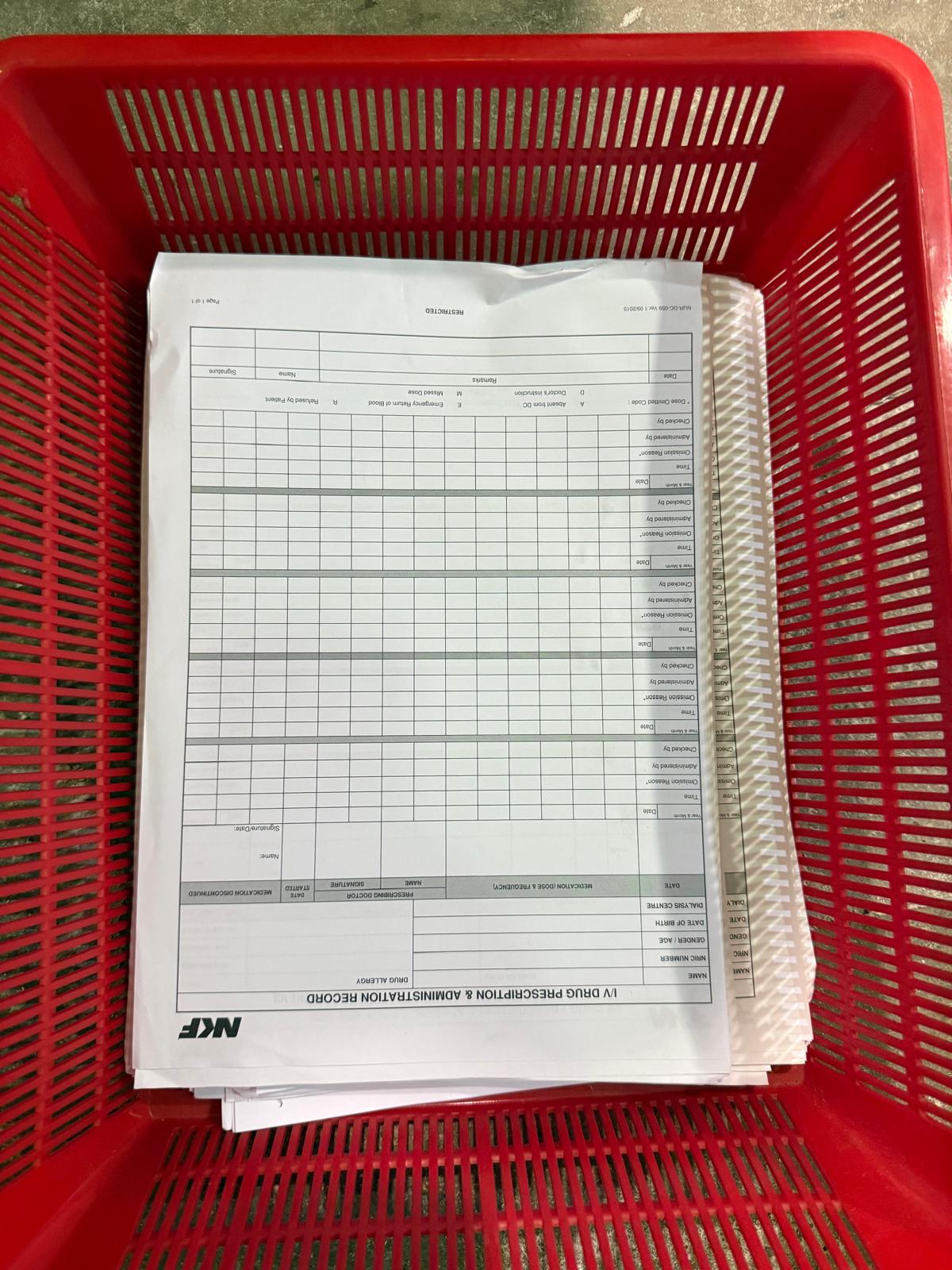
Confidential documents before destruction. Paper volumes accumulate continuously, which favours scheduled collection rather than a single purge event.
Head-to-Head Comparison: On-Site vs Off-Site
The table compares the two models on the dimensions that determine audit defensibility. It describes how each route is structured at BigVoice Secure and, more importantly, what each structure means for the buyer's evidence file.
| Decision dimension | On-site destruction | Off-site destruction |
|---|---|---|
| Custody exposure | Media is destroyed at the client's premises; removal is avoided for the highest-sensitivity items. | Media leaves in locked boxes under scanned inventory and GPS-tracked collection vehicles before destruction at the secure facility. |
| Equipment available | Destruction teams execute on site; confirm at quotation which methods can be deployed to your premises. | Industrial shredders and crushers, SV91m degausser (meets NATO/NSA requirements) and HDD drilling at the 99.45 m² secure destruction site. |
| Media fit | Best suited to defined batches of high-sensitivity devices where removal is restricted. | Best suited to bulk and mixed media: HDD, SSD, laptops, mobile devices, IT equipment and confidential documents. |
| Inventory and scanning | Scanning and inventory can be performed on site before any item moves. | Scanning and inventory performed at collection and reconciled at destruction. |
| Observation of destruction | Client staff can witness the destruction event directly. | CCTV-monitored destruction with chain-of-custody documentation; a CCTV viewing link can be provided afterwards. |
| Documentation | Certificate of Destruction issued after completion; collection and destruction records issued. | Certificate of Destruction issued after completion; destruction report or waste summary report, collection record, service order and delivery order included. |
| Scale and scheduling | Constrained by site access, power and the destruction window; suited to smaller, higher-value batches. | Project and batch based; a reported engagement ran from quotation to certificate in 1–4 weeks depending on asset volume and site schedule. |
| Value recovery | Not the primary purpose of the route. | E-waste buyback can be added, with buyback valuation and payment recorded in the same file as the destruction evidence. |
| Typical trigger | Removal is prohibited, witnessing is mandatory, or sensitivity is exceptionally high. | Volume, mixed media, equipment requirements, scheduled collection or buyback value. |
Note on cost: unit pricing for on-site versus off-site work is not published in the available material, and commercial terms are confirmed at quotation stage. Buyers comparing routes should compare scope — number of custody handovers, scanning coverage, witnessing, CCTV viewing link, certificate scope and buyback offset — rather than a headline rate.
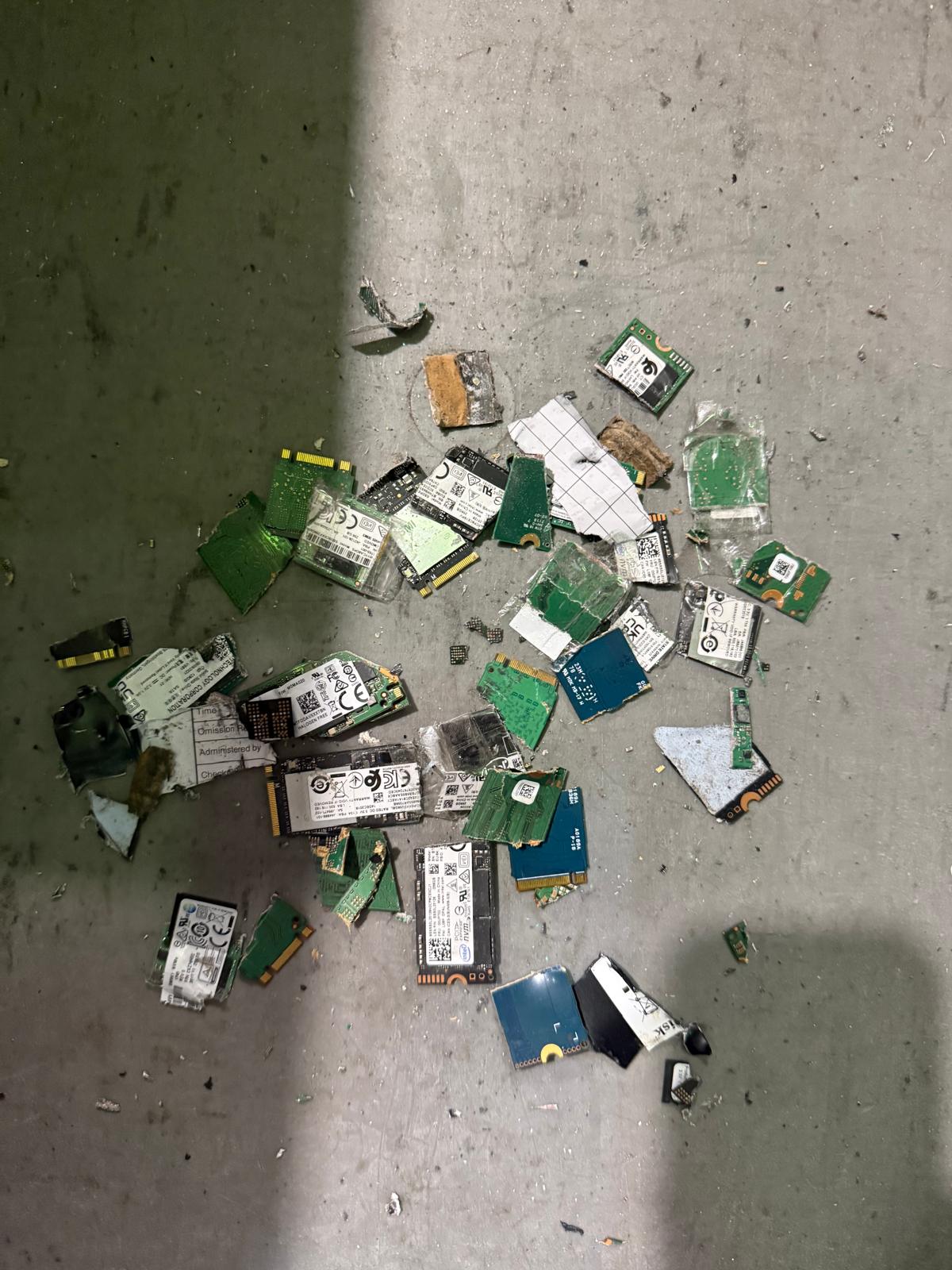
M.2 SSD after physical destruction. The destroyed state is the physical evidence that supports the Certificate of Destruction.
Frequently Asked Questions
1. Does a Certificate of Destruction satisfy an audit requirement for secure data destruction?
A Certificate of Destruction is defined as a formal certificate issued to the client after completion of destruction, evidencing secure disposal. At BigVoice Secure, the certificate is issued on completion of the service, and the documented measurement states that 100% of completed projects were issued a signed Certificate of Destruction. For an audit, the certificate should sit alongside the scanned inventory, collection record and destruction report so that the destroyed items can be reconciled to the items collected. The certificate evidences the process; it does not replace the client's own record of what was handed over.
2. Can on-site destruction handle every media type, including SSDs and paper?
BigVoice Secure provides destruction for hard drives, laptops, mobile devices, IT equipment, confidential documents and other data-bearing media, using industrial shredders and crushers, an SV91m degausser and HDD drilling tools, executed either on site or at the secure facility. The practical constraint is deployment: buyers should confirm at quotation which methods can be run at their premises. Method choice also matters technically — degaussing addresses magnetic media, while NAND-based SSDs require physical destruction to reach the Destroy level defined in NIST SP 800-88 Rev. 1.
3. How should buyers compare budget between the two models?
Published unit pricing for on-site and off-site secure data destruction is not available in the material reviewed here, and BigVoice Secure confirms commercial terms at quotation stage. A practical comparison therefore focuses on what changes the scope: whether scanning is performed on site or off site, whether destruction is witnessed in person or evidenced by CCTV viewing link, how many custody handovers occur, whether confidential documents are included, and whether e-waste buyback offsets part of the cost. Buyback has recovered partial asset value in a reported engagement, so it belongs in the commercial comparison rather than being treated as an afterthought.
4. Can we test the process with a small batch, or witness the destruction?
Yes on both counts, within the limits of the service design. Handling is project and batch based, with capacity and scheduling confirmed with the company, so a first batch can be run through the full documented workflow — quotation, scheduled collection, scanning and locking, destruction by the appropriate method, and certificate issuance. For observation, CCTV-monitored destruction with chain-of-custody documentation is offered and customers can request CCTV viewing of the destruction process; a CCTV viewing link can be issued as part of the deliverables. On-site destruction allows direct witnessing by client staff.
5. How long does it take from booking to Certificate of Destruction?
The workflow runs quote, schedule collection, scanning and locking, destruction by degaussing, shredding or drilling as appropriate, then certificate issuance. In a reported engagement, project duration ran 1–4 weeks depending on asset volume and site schedule, and more than 500 storage media were secured across the project. Buyers with fixed decommissioning dates should confirm the collection slot and certificate turnaround at quotation stage rather than assuming a same-week finish.
Next Step: Get a Route Recommendation and a Quote
BigVoice Secure Destruction Pte. Ltd. operates both on-site and off-site secure destruction in Singapore, with locked box collection, barcode and scan inventory, CCTV-monitored destruction, a Certificate of Destruction on completion, and optional e-waste buyback. Share your media list by type and sensitivity, and the team can advise which items should be destroyed on site and which can move to the secure facility, then issue a quotation.
Phone / WhatsApp: +65 8895 5691 | Email: enquiry@bigvoicesecure.com.sg | Website: www.bigvoicesecure.com.sg
Address: 6 Woodlands Industrial Park E1, Singapore 757729
Download the service brochure: BigVoice Secure promotional brochure (PDF)
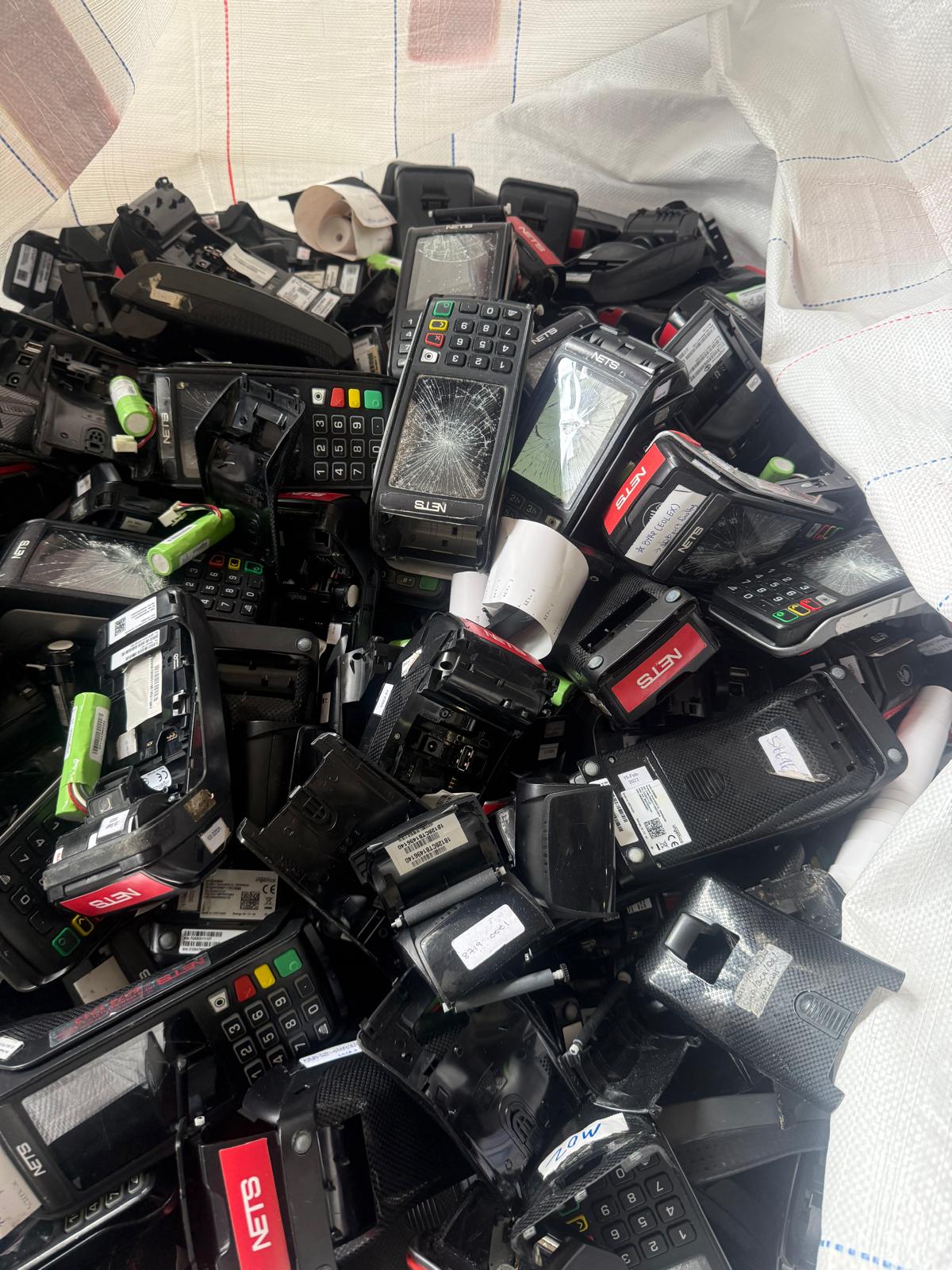
Retired IT assets staged for collection. Whether they are destroyed on site or transported to a secure facility determines how many custody handovers the audit file must document.
Conclusion
The on-site versus off-site decision is not a statement about which supplier is better; it is a statement about where you want your custody risk to sit. On-site destruction keeps the media inside your perimeter and lets your own staff watch it become unrecoverable, at the cost of equipment deployment and a scheduled disruption. Off-site destruction gives you industrial shredding, degaussing and drilling capacity plus a centralised CCTV and documentation record, at the cost of a managed custody gap between collection and destruction.
For most Singapore organisations the answer is a split rule: high-sensitivity devices destroyed on site with scanning before removal, and bulk or mixed media routed through locked boxes, barcode inventory and a secure facility, with both halves closed by the same Certificate of Destruction. Test the rule on a first batch, check that the inventory, CCTV evidence and certificate reconcile, and only then scale the programme.
Have Questions or Need More Details?
Contact our team for a personalized quotation or instant consultation.
Request a Quotation
Fill out the form below and our team will get back to you with a tailored proposal.
WhatsApp Direct Chat
Prefer to chat in real-time? Message us on WhatsApp for instant assistance & quick answers.
- Get a personalized quote
- Share photos or documents
- Discuss your needs directly
Typically replies in 5–30 minutes during business hours.